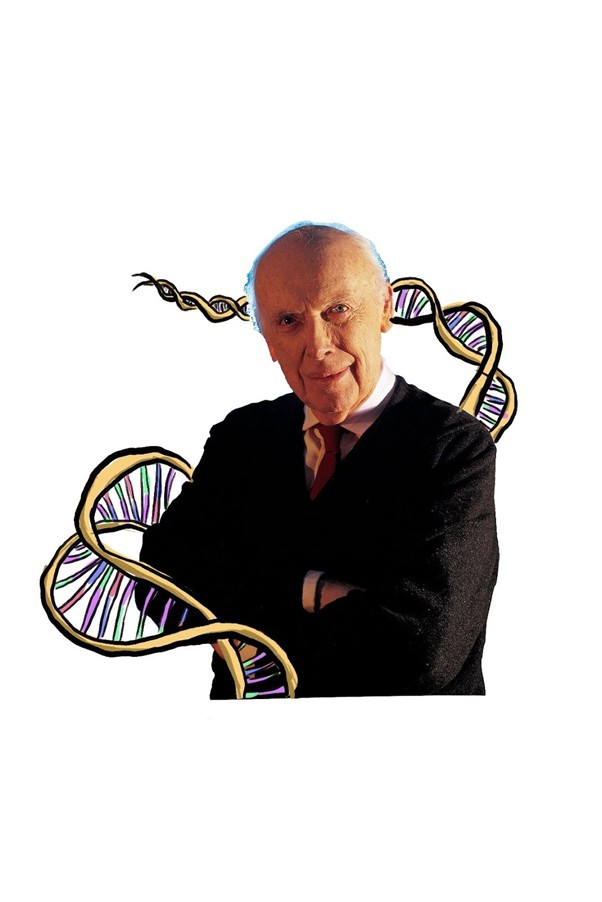
In the age of the genetics revolution, it’s easy to forget how far our understanding of DNA has come in just one lifetime: the lifetime of James Watson.
Having passed away, his death gives us a chance to reflect not only on his vital work with nucleic acids, but also his personal views and the future of his field. Identifying the double helical structure of DNA at just 25 years old, the rest of his life would be characterised by an often-abrasive engagement in public discourse, at times controversial.
The story of James Watson, therefore, cannot be told without acknowledging both his complicated legacy and scientific importance. Watson’s research has improved and saved millions of lives, and countless more will benefit as genomic medicine becomes increasingly prevalent.
Over 70 years ago, would Watson have been able to predict how his work would lead to a blood-stained cloth being used to analyse Adolf Hitler’s DNA? Would he have been able to foresee the ethical discourse around genetics? The field of genetics has undergone an unprecedented evolution in only one man’s lifetime, but the most pressing question is how it will continue to evolve.
James Watson: Pioneer
Born in the spring of 1928, James Watson seemed to have always been destined for a career in genetics. By age 11, he’d stopped attending Mass to devote himself to ‘the pursuit of scientific and humanistic knowledge’, viewing this as the ‘best route to successful living’. After his BSc and PhD, Watson truly came to prominence when he and Francis Crick published their seminal 1953 paper ‘A Structure for Deoxyribose Nucleic Acid’ in Nature.
Prior to this, our understanding of the molecular basis of genetics was patchy at best. Since the late 1800s, we have known about phosphate-sugar-base nucleic acids, but proteins were thought of as the genetic material. After all, their 20 amino acid composition seemed far more complex than DNA’s. In 1944, the landmark Avery-Macleod-McCarty experiment proved DNA was the hereditary medium, inspiring American biochemist Erwin Chargraff’s discovery of adenine and thymine’s presence in equal amounts. In 1952, Chargraff would give a lecture on his findings to an audience of Cambridge academics – among them the would-be pioneering duo: Watson and Crick.
Working out of the Cavendish lab, they published their infamously short paper (just over a page), describing DNA’s double helical structure with two antiparallel strands and specific base pairing, while predicting how each chain might act as a template for replication. James Watson would share the Nobel Prize in 1962 with Francis Crick and Maurice Wilkins. At the age of 34, he had become a laureate seven years before his own PhD supervisor. Their work shifted the focus of genetic discussion from abstract patterns of inheritance to precise molecular mechanisms, paving the way for understanding the nature of disease-causing mutations, genetic engineering, and DNA sequencing. Without James Watson, there is no modern-day genetics.
But why does any of this matter? Genetics is everywhere. On a global scale, over 1 billion doses of the recombinant hepatitis B vaccine have been administered, saving countless lives since the 1980s. For diabetics, synthetic insulin has been a game changer in increasing the quality and duration of life for millions. Even beyond medicine, when they discovered the body of King Richard III underneath a Leicester car park, it was mtDNA comparison with a living relative that helped confirm that the skeleton was his. Who can forget the widespread PCR testing during the Covid-19 pandemic.
Even in his later life, he remained a passionate voice within the scientific community. James Watson was an early head of the Human Genome Project (running from 1990-2003), that aimed to sequence and map the entire genetic code. While he would leave in 1992 due to internal disagreements, the HGP set an unprecedented standard for global scientific collaboration, with Watson’s endorsement giving it legitimacy in its early days. Throughout the 21st century, he had been a firm believer that ‘the human genome belongs to the world’s peoples’. In fact, Watson was the second person ever to have their whole genome published online in 2007, with the hope that this would usher in a new age of personalised medicine.
From vaccines to diagnostics to treatment of chronic conditions, his research has proved key to unravelling disease as we knew it, with lifelong advocacy of transparency truly cementing Watson as one of the most influential scientists of the 20th century.
Unfortunately, it is possible to be both an influential figure and a reprehensible person.
James Watson: Pariah
With a reputation as a fiercely competitive scientist, his unwillingness to credit the English chemist Rosalind Franklin is perhaps Watson’s most well-known controversy. Franklin and Maurice Wilkins had been working together to produce X-ray diffraction images of DNA, when Franklin’s PhD student (under her supervision) took the famous ‘Photo 51’. Wilkins, without Franklin’s knowledge or consent, shared this image with Watson. Watson was instantly able to recognise its importance in revealing a double helical structure, massively accelerating the work that would bring him fame. Yet, despite how crucial Franklin is to the story, it is not her name that the Nobel Prize bears. Nor had she been offered to co-author the famous 1953 paper like Wilkins had. Even in Watson’s own autobiography, he states ‘clearly Rosy had to be put in her place’, continuously referring to Franklin in belittling and sexist terms. Passing away in 1958 at only 37 years old, she would never live to witness the huge impact of her work. Watson’s sexist attitudes did not just pertain to Franklin, but female scientists collectively – believing their presence in the lab was ‘more fun for the men’, but that they were ‘probably less effective’.
Watson did not just discriminate based on gender, but race too. In 2000, he delivered a lecture suggesting darker-skinned people had higher libidos due to increased melanin – an entirely unsupported claim. Furthermore, he made repeated statements that interracial IQ differences were purely genetic, making him feel ‘inherently gloomy about the prospect of Africa’. Watson was remarkably inclusive in his racism, also expressing distasteful views on genetically encoded stereotypes about Jewish, Chinese and Indian people.
Watson also had his own views on biotechnology, with some outlooks that could be described as flirting with eugenics. While opposing state-mandated gene editing, he was in favour of genetic screening, selection, and non-essential embryonic gene editing. In 1997 he stated, ‘if you could find the gene which determines sexuality and a woman decides she doesn’t want a homosexual child, well, let her’. Even in public lecturs, he argued ‘stupidity’ must be viewed as a disease to be cured.
For his abhorrent opinions on sex, race, and eugenics, the Cold Spring Harbour Laboratory which he had given 40 years of his life would suspend him and revoke his honorary titles in 2007, with Watson receiving public condemnation from the wider scientific community.
Beyond Watson: Where to next?
James Watson’s legacy begs the question: can we separate the art from the artist?
With personal views that were nothing short of repulsive and detestable, it is difficult to praise Watson as a person. However, in his mid-twenties, he published one of the most influential papers in medical history. Within his lifetime, we’ve progressed from the genetic Stone Age to CRISPR-Cas9 gene editing: an unprecedented change. From here, who knows how far genetics will go in our own lifetimes?
Our lives will be marked by a rapid change in not only our understanding of genetics, but how we use this understanding. In 20 years, the cost of a whole genome sequence has gone from over £100 million to under £500 – low enough for the NHS to offer them for 100,000 newborns as part of the ongoing Generation Study. With the rise of AI lowering the cost of data analysis, genome sequencing will only become a more common diagnostic tool. We’re also seeing the dawn of gene-editing therapies like Casgevy, the first of its kind used in the NHS. Using CRISPR to edit a patient’s own stem cells and correct faulty genes causing sickle cell disease and β-thalassemia eliminates the need for a donor and may potentially cure the disease for life. These few examples offer a brief glimpse into the future: using our understanding of genetics and combining that with modern tech to have a real impact on real patients.
Such rapid advancement in genetics has transformed our idea of what we could do, begging the inevitable question of what we should do. Who owns your genetic information? Could people with genetic predispositions to certain conditions pay more insurance? What constitutes a disease worth editing out of the genome? How do babies consent to their lifelong, permanent genetic information being processed? The genetic future is riddled with challenges that cannot so easily be spliced out.
James Watson’s beliefs betray the complexity of humanity that he helped reveal. His work unlocked the code of life, but he did not provide a guide on how it should be used. As we continue to rewrite how we use genetics, the most dangerous errors may not be biological mutations, but moral ones.
In the age of the genetics revolution, it’s easy to forget how far our understanding of DNA has come in just one lifetime: the lifetime of James Watson.
Having passed away, his death gives us a chance to reflect not only on his vital work with nucleic acids, but also his personal views and the future of his field. Identifying the double helical structure of DNA at just 25 years old, the rest of his life would be characterised by an often-abrasive engagement in public discourse, at times controversial.
The story of James Watson, therefore, cannot be told without acknowledging both his complicated legacy and scientific importance. Watson’s research has improved and saved millions of lives, and countless more will benefit as genomic medicine becomes increasingly prevalent.
Over 70 years ago, would Watson have been able to predict how his work would lead to a blood-stained cloth being used to analyse Adolf Hitler’s DNA? Would he have been able to foresee the ethical discourse around genetics? The field of genetics has undergone an unprecedented evolution in only one man’s lifetime, but the most pressing question is how it will continue to evolve.
James Watson: Pioneer
Born in the spring of 1928, James Watson seemed to have always been destined for a career in genetics. By age 11, he’d stopped attending Mass to devote himself to ‘the pursuit of scientific and humanistic knowledge’, viewing this as the ‘best route to successful living’. After his BSc and PhD, Watson truly came to prominence when he and Francis Crick published their seminal 1953 paper ‘A Structure for Deoxyribose Nucleic Acid’ in Nature.
Prior to this, our understanding of the molecular basis of genetics was patchy at best. Since the late 1800s, we have known about phosphate-sugar-base nucleic acids, but proteins were thought of as the genetic material. After all, their 20 amino acid composition seemed far more complex than DNA’s. In 1944, the landmark Avery-Macleod-McCarty experiment proved DNA was the hereditary medium, inspiring American biochemist Erwin Chargraff’s discovery of adenine and thymine’s presence in equal amounts. In 1952, Chargraff would give a lecture on his findings to an audience of Cambridge academics – among them the would-be pioneering duo: Watson and Crick.
Working out of the Cavendish lab, they published their infamously short paper (just over a page), describing DNA’s double helical structure with two antiparallel strands and specific base pairing, while predicting how each chain might act as a template for replication. James Watson would share the Nobel Prize in 1962 with Francis Crick and Maurice Wilkins. At the age of 34, he had become a laureate seven years before his own PhD supervisor. Their work shifted the focus of genetic discussion from abstract patterns of inheritance to precise molecular mechanisms, paving the way for understanding the nature of disease-causing mutations, genetic engineering, and DNA sequencing. Without James Watson, there is no modern-day genetics.
But why does any of this matter? Genetics is everywhere. On a global scale, over 1 billion doses of the recombinant hepatitis B vaccine have been administered, saving countless lives since the 1980s. For diabetics, synthetic insulin has been a game changer in increasing the quality and duration of life for millions. Even beyond medicine, when they discovered the body of King Richard III underneath a Leicester car park, it was mtDNA comparison with a living relative that helped confirm that the skeleton was his. Who can forget the widespread PCR testing during the Covid-19 pandemic.
Even in his later life, he remained a passionate voice within the scientific community. James Watson was an early head of the Human Genome Project (running from 1990-2003), that aimed to sequence and map the entire genetic code. While he would leave in 1992 due to internal disagreements, the HGP set an unprecedented standard for global scientific collaboration, with Watson’s endorsement giving it legitimacy in its early days. Throughout the 21st century, he had been a firm believer that ‘the human genome belongs to the world’s peoples’. In fact, Watson was the second person ever to have their whole genome published online in 2007, with the hope that this would usher in a new age of personalised medicine.
From vaccines to diagnostics to treatment of chronic conditions, his research has proved key to unravelling disease as we knew it, with lifelong advocacy of transparency truly cementing Watson as one of the most influential scientists of the 20th century.
Unfortunately, it is possible to be both an influential figure and a reprehensible person.
James Watson: Pariah
With a reputation as a fiercely competitive scientist, his unwillingness to credit the English chemist Rosalind Franklin is perhaps Watson’s most well-known controversy. Franklin and Maurice Wilkins had been working together to produce X-ray diffraction images of DNA, when Franklin’s PhD student (under her supervision) took the famous ‘Photo 51’. Wilkins, without Franklin’s knowledge or consent, shared this image with Watson. Watson was instantly able to recognise its importance in revealing a double helical structure, massively accelerating the work that would bring him fame. Yet, despite how crucial Franklin is to the story, it is not her name that the Nobel Prize bears. Nor had she been offered to co-author the famous 1953 paper like Wilkins had. Even in Watson’s own autobiography, he states ‘clearly Rosy had to be put in her place’, continuously referring to Franklin in belittling and sexist terms. Passing away in 1958 at only 37 years old, she would never live to witness the huge impact of her work. Watson’s sexist attitudes did not just pertain to Franklin, but female scientists collectively – believing their presence in the lab was ‘more fun for the men’, but that they were ‘probably less effective’.
Watson did not just discriminate based on gender, but race too. In 2000, he delivered a lecture suggesting darker-skinned people had higher libidos due to increased melanin – an entirely unsupported claim. Furthermore, he made repeated statements that interracial IQ differences were purely genetic, making him feel ‘inherently gloomy about the prospect of Africa’. Watson was remarkably inclusive in his racism, also expressing distasteful views on genetically encoded stereotypes about Jewish, Chinese and Indian people.
Watson also had his own views on biotechnology, with some outlooks that could be described as flirting with eugenics. While opposing state-mandated gene editing, he was in favour of genetic screening, selection, and non-essential embryonic gene editing. In 1997 he stated, ‘if you could find the gene which determines sexuality and a woman decides she doesn’t want a homosexual child, well, let her’. Even in public lecturs, he argued ‘stupidity’ must be viewed as a disease to be cured.
For his abhorrent opinions on sex, race, and eugenics, the Cold Spring Harbour Laboratory which he had given 40 years of his life would suspend him and revoke his honorary titles in 2007, with Watson receiving public condemnation from the wider scientific community.
Beyond Watson: Where to next?
James Watson’s legacy begs the question: can we separate the art from the artist?
With personal views that were nothing short of repulsive and detestable, it is difficult to praise Watson as a person. However, in his mid-twenties, he published one of the most influential papers in medical history. Within his lifetime, we’ve progressed from the genetic Stone Age to CRISPR-Cas9 gene editing: an unprecedented change. From here, who knows how far genetics will go in our own lifetimes?
Our lives will be marked by a rapid change in not only our understanding of genetics, but how we use this understanding. In 20 years, the cost of a whole genome sequence has gone from over £100 million to under £500 – low enough for the NHS to offer them for 100,000 newborns as part of the ongoing Generation Study. With the rise of AI lowering the cost of data analysis, genome sequencing will only become a more common diagnostic tool. We’re also seeing the dawn of gene-editing therapies like Casgevy, the first of its kind used in the NHS. Using CRISPR to edit a patient’s own stem cells and correct faulty genes causing sickle cell disease and β-thalassemia eliminates the need for a donor and may potentially cure the disease for life. These few examples offer a brief glimpse into the future: using our understanding of genetics and combining that with modern tech to have a real impact on real patients.
Such rapid advancement in genetics has transformed our idea of what we could do, begging the inevitable question of what we should do. Who owns your genetic information? Could people with genetic predispositions to certain conditions pay more insurance? What constitutes a disease worth editing out of the genome? How do babies consent to their lifelong, permanent genetic information being processed? The genetic future is riddled with challenges that cannot so easily be spliced out.
James Watson’s beliefs betray the complexity of humanity that he helped reveal. His work unlocked the code of life, but he did not provide a guide on how it should be used. As we continue to rewrite how we use genetics, the most dangerous errors may not be biological mutations, but moral ones.