Part 1: Mountains out of (mole)hills
I don’t know why I put myself through this.
At the bottom of Headington Hill, the road stretches upwards. The incline glows faintly gold, sun filtered through damp autumn air. From here, it never looks bad – just a gentle climb. But I know better.
A blue Ford Focus idles to my right, engine purring like a cat too content to move. The traffic lights flash amber. My heart braces. My calves tighten with anticipation.
Then green.
I pedal hard. My bike jolts forwards as the wind slices past my face, laced with the metallic tang of exhaust. The gradient steepens. My thighs seize; my lungs scrape for air. I drop the gears – four, three, two, one – each click, a small act of surrender. The Ford glides ahead, indifferent and unbothered. My cheeks flush a little.
Up ahead, a cyclist walks her grey bike on the pavement. “Loser,” I mutter under my breath, failing to mask the envy creeping up alongside the fatigue.
I try to drown out the steady pulse of pain with the ramblings of last week’s metabolism lectures. ‘One molecule of triglyceride produces 104 ATPs; glucose only 32.’ I recite it like a mantra. But it does nothing. Every breath tastes like copper.
I’ve conquered this climb twice already, on the way to my GP placements. There’s no reason why I couldn’t win again. My defiance alone pushes me over the peak. As the road finally softens, I release a sound, halfway between a sigh and a laugh. I use the descent to catch my breath as I pedal onwards, to the John Radcliffe.
Part 2: In Borrowed Blue
The automatic doors hiss open as I enter. A gust of antiseptic assaults my nostrils, carrying with it memories of St George’s – back when I was just a hopeful sixth former with a visitor’s badge and no real place to stand. I wonder if anything has changed since.
I’m not quite sure what I was doing here as a first-year. A couple of weeks ago, I emailed a radiology lecturer on a whim asking to spend the day in their department. Why, you may ask? I’m hardly the keen type. But lately, the endless lectures and practicals I was being bombarded with have begun to blur into meaningless jargon.
I needed some motivation. I needed to see something real. To remind me why I chose this degree. Telephoning GP patients once a month just doesn’t cut it.
I skim the signs as I walk past them. ‘Endoscopy’, ‘Outpatients’, ‘Wards’. Finally, ‘Radiology Level 2: X-Rays’. This must be it.
I walk up to the automatic doors, which refuse to budge. A card reader blinks accusingly to my right. I try my Bodcard. Nothing. Out of optimism – or sheer delusion – I try my credit card. Still nothing. Perhaps a message from the universe to turn back.
Not yet.
I lean toward the glass, awkwardly waving until the receptionist looks up from The Times reluctantly, and buzzes me in.
“I’m here to visit Susan,” I announce, failing to sound official. I hope she didn’t think I was a patient.
“She’s in a meeting.” She peers at me over the page with an air of disdain, “I’ll take you to the changing rooms first.”
Changing rooms? Right. Scrubs. Finally, the opportunity to look like a real doctor – or at least, like the ones in medical dramas.
After a series of disorienting lefts and rights, I reach the changing room. I pull on a set of scrubs and stare at my reflection, half-expecting competence to surge through me like Ironman’s suit booting up. Nothing. Only an imposter in borrowed blue. Still, before leaving, I take a quick mirror selfie as a souvenir.
The temptation just proves too strong.
Part 3: Learning to Swim
The radiology department hums with quiet purpose, machines clicking, monitors whirring. I step inside unnoticed; not a head turns. As I hover by the corridor awkwardly, for the first time, I truly understand what ‘shadowing’ means.
A woman in her late forties strides down the corridor, papers in hand. Her dark hair is slicked back, thick-framed glasses catching the overhead light. Just as she is about to walk past me, I pounce.
“Hello.”
“Yes?”
“I’m here to meet Susan. Do you know where she is?”
She turns, the name catching her full attention for the first time. She sweeps me from head to toe, eyes narrowing slightly, as if decoding my purpose. “Ah, the medical student. I’m the anaesthetist – you will start by shadowing me today. We’re starting soon. Follow me.”
I have no other choice but to slip into her shadow.
We stop at a door labelled: ‘Controlled Area, X-rays’. Hanging beside the room are rows of thick, red lifejackets, appearing as heavy as medieval armour. Ominous, if not puzzling.
Before I can comment, I notice a small crowd beginning to form. Everyone seems to be wearing the lifejackets. They remind me of toddlers about to swim for the first time.
A tall, white-haired man in green scrubs follows. Instinct recognises him before my mind does – like a wolf sensing the alpha without needing to be told.
“Looks like everyone is here,” his voice reverberates. “Before we start: introductions. I’m Dr. Gianno, consultant radiologist.”
“Registrar.”
“Scrub nurse.”
“Radiographer.”
“Anaesthetist.”
Finally, it comes to me: “Medical student.” There was no chance I’d admit to being a first-year. Even a senior medical student’s status in the hospital is on par with that of eduroam in Osler mess (spoilers: neither exists).
The briefing begins. The patient, a 48-year-old man, has a clot in his left brachial vein. The words flow quickly, most lost to my inexperience, but I catch enough to understand this will be an interventional radiology case. Something high-stakes, fastidious and precise.
Part 4: In the Theatre
Inside the X-ray suite, the world is only metal and light. The air is colder here, filtered and sterile. A robotic C-arm dominates the centre, curved over the table like a question mark. Two enormous screens hang overhead, dark for now. To one side, a computer console bombinates with a dry, mechanical tremor.
I watch the script unfold. Everyone knows their part, like a cog in a well-oiled machine. The scrub nurse lays out gleaming instruments in neat rows. The consultant scrubs his hands with iodine, his movements ritualistic, while the anaesthetist vanishes to fetch the patient. Me? I flatten my back against the wall as much as I can, trying not to breathe too loudly. Some cogs are more important than others.
The registrar turns to me. “You’re the medical student, right?”
I nod.
“Do you want to put on your apron?”
“Apron?”
“Yes, the lead apron,” she points to the toddler’s lifejacket that encases her.
I curse in my head silently for not putting two and two together. Of course. Protection. Looks like my A-level in Physics was useless.
I grab a large apron from the rack outside and instinctively try to put it on like a jumper. Unfortunately, my head and glasses do not quite fit through the gap. My attempts to take it off, entertainingly for the others, are futile.
A nurse walking past laughs softly before offering her generosity. “Unstrap it first, like a jacket. See?”
“There you go. First day in radiology?”
I manage a grimace of a grin. Great. Another core memory.
Part 5: Dolmio’s Bolognese
When I finally return, sweating under the weight of my armour, the patient is already prepped beneath the C-arm, staring at the ceiling. The anaesthetist sits by the monitor, flipping casually through a book between occasional glances at the screen.
Dr. Gianno nods to the radiographer and with a few deft taps, the TV screens flicker to life. A coronal section of the patient’s arm appears — faint outlines of vessels branching like ghostly shadows. The consultant murmurs reassurances to the patient, explaining what I am sure he already knows. Then he begins. Working with unwavering concentration and mechanical precision, he eventually threads a slender tube into the vein.
“Injecting the dye,” a stray voice breaks the silence.
On screen, I see the vessels darkening with iodine, tracing delicate paths until the contrast hurtles to a halt, hitting an obsidian dam of trapped blood: the clot. The registrar sets down a transparent container on the table, the word ‘Penumbra’ printed across it, before the consultant connects it to his tube, and pushes a button.
What ensues is morbidly mesmerising.
A low, deliberate drone fills the room as the machine stirs. Dark liquid surges through the tube and gathers in the container, clot and blood swirling like paint in water. The machine is a vacuum, built to clear the narrowest of pipes. My stomach recoils, but fascination ultimately wins.
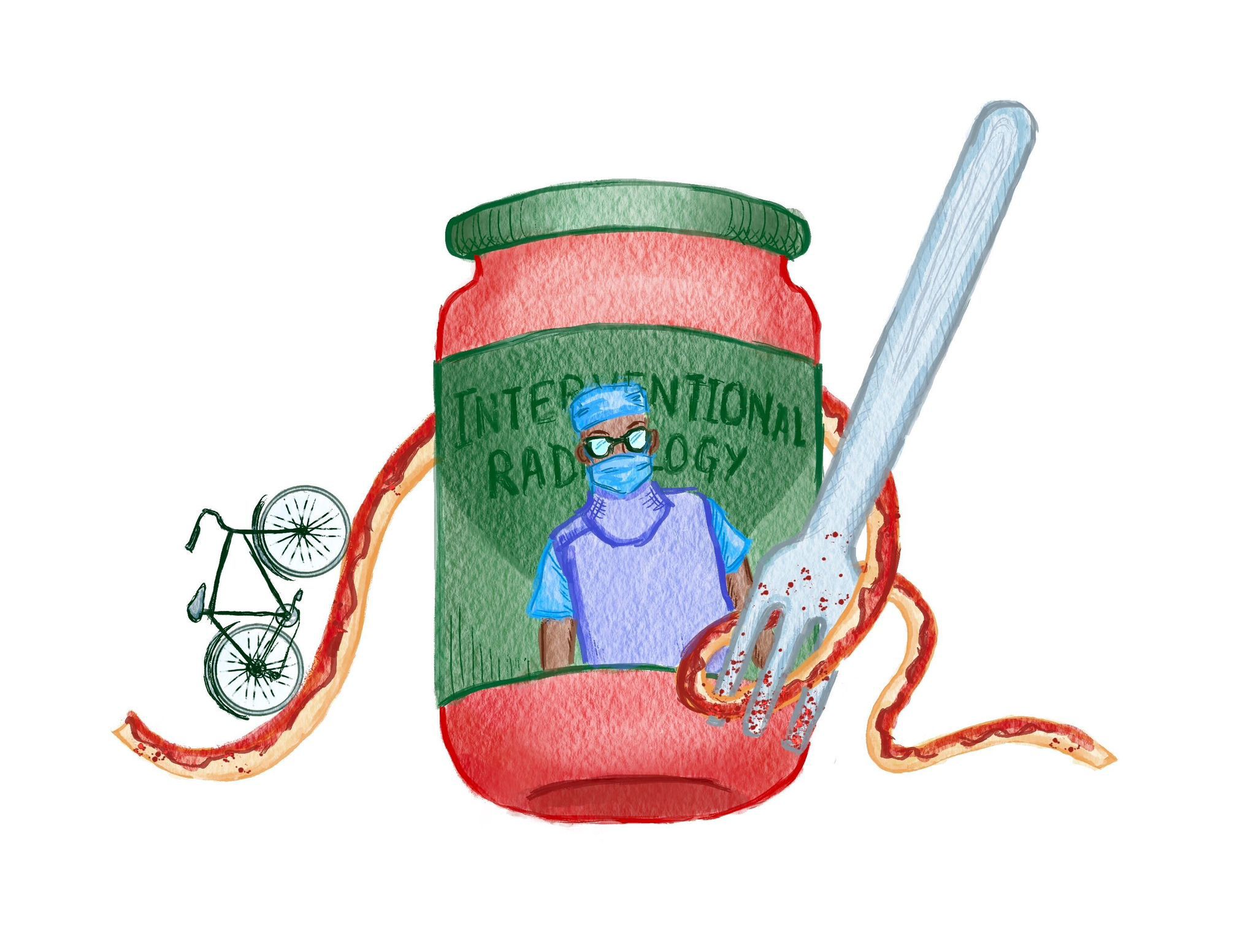
The suction goes on for a while. Now, thick, tomatoey sludge oozes down the line. Whenever queasiness threatens, I tell myself, it’s just Dolmio’s Bolognese sauce. Strangely, it works. It is an oddly satisfying sight, yet humbling too. These small crimson clots draw us all into the same room, the reason why everyone has come to work today. It’s moments like this that remind me why I continue to pedal uphill.
Eventually, the sludge clears. The blockage is gone, replaced by beautiful, laminar blood gliding through the vein. For the first time, the patient stirs.
“Can you take a photo of the clot with me in it, Doc? Gotta show the family, innit. ”
I stay silent, my mind flickering back to my own scrubs selfie. Maybe we aren’t so different after all.
Illustrated by Anna Rooth.
Part 1: Mountains out of (mole)hills
I don’t know why I put myself through this.
At the bottom of Headington Hill, the road stretches upwards. The incline glows faintly gold, sun filtered through damp autumn air. From here, it never looks bad – just a gentle climb. But I know better.
A blue Ford Focus idles to my right, engine purring like a cat too content to move. The traffic lights flash amber. My heart braces. My calves tighten with anticipation.
Then green.
I pedal hard. My bike jolts forwards as the wind slices past my face, laced with the metallic tang of exhaust. The gradient steepens. My thighs seize; my lungs scrape for air. I drop the gears – four, three, two, one – each click, a small act of surrender. The Ford glides ahead, indifferent and unbothered. My cheeks flush a little.
Up ahead, a cyclist walks her grey bike on the pavement. “Loser,” I mutter under my breath, failing to mask the envy creeping up alongside the fatigue.
I try to drown out the steady pulse of pain with the ramblings of last week’s metabolism lectures. ‘One molecule of triglyceride produces 104 ATPs; glucose only 32.’ I recite it like a mantra. But it does nothing. Every breath tastes like copper.
I’ve conquered this climb twice already, on the way to my GP placements. There’s no reason why I couldn’t win again. My defiance alone pushes me over the peak. As the road finally softens, I release a sound, halfway between a sigh and a laugh. I use the descent to catch my breath as I pedal onwards, to the John Radcliffe.
Part 2: In Borrowed Blue
The automatic doors hiss open as I enter. A gust of antiseptic assaults my nostrils, carrying with it memories of St George’s – back when I was just a hopeful sixth former with a visitor’s badge and no real place to stand. I wonder if anything has changed since.
I’m not quite sure what I was doing here as a first-year. A couple of weeks ago, I emailed a radiology lecturer on a whim asking to spend the day in their department. Why, you may ask? I’m hardly the keen type. But lately, the endless lectures and practicals I was being bombarded with have begun to blur into meaningless jargon.
I needed some motivation. I needed to see something real. To remind me why I chose this degree. Telephoning GP patients once a month just doesn’t cut it.
I skim the signs as I walk past them. ‘Endoscopy’, ‘Outpatients’, ‘Wards’. Finally, ‘Radiology Level 2: X-Rays’. This must be it.
I walk up to the automatic doors, which refuse to budge. A card reader blinks accusingly to my right. I try my Bodcard. Nothing. Out of optimism – or sheer delusion – I try my credit card. Still nothing. Perhaps a message from the universe to turn back.
Not yet.
I lean toward the glass, awkwardly waving until the receptionist looks up from The Times reluctantly, and buzzes me in.
“I’m here to visit Susan,” I announce, failing to sound official. I hope she didn’t think I was a patient.
“She’s in a meeting.” She peers at me over the page with an air of disdain, “I’ll take you to the changing rooms first.”
Changing rooms? Right. Scrubs. Finally, the opportunity to look like a real doctor – or at least, like the ones in medical dramas.
After a series of disorienting lefts and rights, I reach the changing room. I pull on a set of scrubs and stare at my reflection, half-expecting competence to surge through me like Ironman’s suit booting up. Nothing. Only an imposter in borrowed blue. Still, before leaving, I take a quick mirror selfie as a souvenir.
The temptation just proves too strong.
Part 3: Learning to Swim
The radiology department hums with quiet purpose, machines clicking, monitors whirring. I step inside unnoticed; not a head turns. As I hover by the corridor awkwardly, for the first time, I truly understand what ‘shadowing’ means.
A woman in her late forties strides down the corridor, papers in hand. Her dark hair is slicked back, thick-framed glasses catching the overhead light. Just as she is about to walk past me, I pounce.
“Hello.”
“Yes?”
“I’m here to meet Susan. Do you know where she is?”
She turns, the name catching her full attention for the first time. She sweeps me from head to toe, eyes narrowing slightly, as if decoding my purpose. “Ah, the medical student. I’m the anaesthetist – you will start by shadowing me today. We’re starting soon. Follow me.”
I have no other choice but to slip into her shadow.
We stop at a door labelled: ‘Controlled Area, X-rays’. Hanging beside the room are rows of thick, red lifejackets, appearing as heavy as medieval armour. Ominous, if not puzzling.
Before I can comment, I notice a small crowd beginning to form. Everyone seems to be wearing the lifejackets. They remind me of toddlers about to swim for the first time.
A tall, white-haired man in green scrubs follows. Instinct recognises him before my mind does – like a wolf sensing the alpha without needing to be told.
“Looks like everyone is here,” his voice reverberates. “Before we start: introductions. I’m Dr. Gianno, consultant radiologist.”
“Registrar.”
“Scrub nurse.”
“Radiographer.”
“Anaesthetist.”
Finally, it comes to me: “Medical student.” There was no chance I’d admit to being a first-year. Even a senior medical student’s status in the hospital is on par with that of eduroam in Osler mess (spoilers: neither exists).
The briefing begins. The patient, a 48-year-old man, has a clot in his left brachial vein. The words flow quickly, most lost to my inexperience, but I catch enough to understand this will be an interventional radiology case. Something high-stakes, fastidious and precise.
Part 4: In the Theatre
Inside the X-ray suite, the world is only metal and light. The air is colder here, filtered and sterile. A robotic C-arm dominates the centre, curved over the table like a question mark. Two enormous screens hang overhead, dark for now. To one side, a computer console bombinates with a dry, mechanical tremor.
I watch the script unfold. Everyone knows their part, like a cog in a well-oiled machine. The scrub nurse lays out gleaming instruments in neat rows. The consultant scrubs his hands with iodine, his movements ritualistic, while the anaesthetist vanishes to fetch the patient. Me? I flatten my back against the wall as much as I can, trying not to breathe too loudly. Some cogs are more important than others.
The registrar turns to me. “You’re the medical student, right?”
I nod.
“Do you want to put on your apron?”
“Apron?”
“Yes, the lead apron,” she points to the toddler’s lifejacket that encases her.
I curse in my head silently for not putting two and two together. Of course. Protection. Looks like my A-level in Physics was useless.
I grab a large apron from the rack outside and instinctively try to put it on like a jumper. Unfortunately, my head and glasses do not quite fit through the gap. My attempts to take it off, entertainingly for the others, are futile.
A nurse walking past laughs softly before offering her generosity. “Unstrap it first, like a jacket. See?”
“There you go. First day in radiology?”
I manage a grimace of a grin. Great. Another core memory.
Part 5: Dolmio’s Bolognese
When I finally return, sweating under the weight of my armour, the patient is already prepped beneath the C-arm, staring at the ceiling. The anaesthetist sits by the monitor, flipping casually through a book between occasional glances at the screen.
Dr. Gianno nods to the radiographer and with a few deft taps, the TV screens flicker to life. A coronal section of the patient’s arm appears — faint outlines of vessels branching like ghostly shadows. The consultant murmurs reassurances to the patient, explaining what I am sure he already knows. Then he begins. Working with unwavering concentration and mechanical precision, he eventually threads a slender tube into the vein.
“Injecting the dye,” a stray voice breaks the silence.
On screen, I see the vessels darkening with iodine, tracing delicate paths until the contrast hurtles to a halt, hitting an obsidian dam of trapped blood: the clot. The registrar sets down a transparent container on the table, the word ‘Penumbra’ printed across it, before the consultant connects it to his tube, and pushes a button.
What ensues is morbidly mesmerising.
A low, deliberate drone fills the room as the machine stirs. Dark liquid surges through the tube and gathers in the container, clot and blood swirling like paint in water. The machine is a vacuum, built to clear the narrowest of pipes. My stomach recoils, but fascination ultimately wins.
The suction goes on for a while. Now, thick, tomatoey sludge oozes down the line. Whenever queasiness threatens, I tell myself, it’s just Dolmio’s Bolognese sauce. Strangely, it works. It is an oddly satisfying sight, yet humbling too. These small crimson clots draw us all into the same room, the reason why everyone has come to work today. It’s moments like this that remind me why I continue to pedal uphill.
Eventually, the sludge clears. The blockage is gone, replaced by beautiful, laminar blood gliding through the vein. For the first time, the patient stirs.
“Can you take a photo of the clot with me in it, Doc? Gotta show the family, innit. ”
I stay silent, my mind flickering back to my own scrubs selfie. Maybe we aren’t so different after all.
Illustrated by Anna Rooth.