
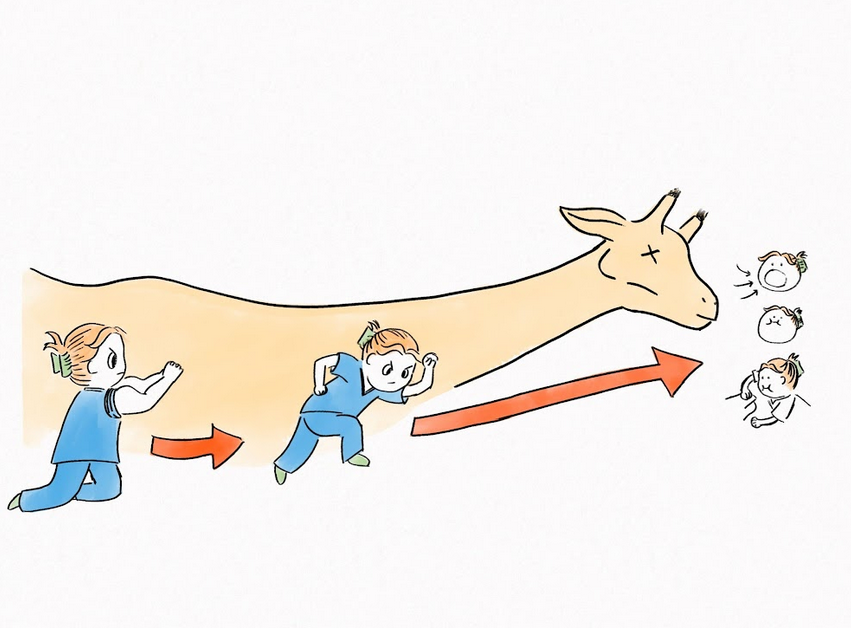
We’ve all been there. You’re walking back from the MSTC when all of a sudden, a giraffe collapses in front of you. Just your luck, eh? You might have learnt how to do CPR on humans, but the tallest species on the planet is a completely different ball game.
What do you do when faced with an animal 4-6 metres tall, weighing around a tonne (for scale, that’s 400 copies of Guyton and Hall’s Physiology), with unique physiological and anatomical adaptations, and extraordinarily little research? Simple. You take recent human and veterinary guidelines and try your best to apply them to this highly-realistic scenario.
Why Do We Perform Cardiopulmonary Resuscitation (CPR)?
CPR is performed in response to cardiac arrest: a sudden failure of the heart bringing its contraction and blood flow to a standstill. Many causes can lead to this, from coronary heart disease to electrolyte imbalances. Cardiac arrest starves the brain’s respiratory centre of sufficient oxygen which, in a cruel twist of fate, precipitates respiratory arrest.
CPR helps maximise chances of survival and minimise organ damage (particularly to the brain) by manually maintaining blood flow and oxygenation until heart function can be restored. Factors such as hypoxia and how well one’s body conserves oxygen determine how long a brain survives following cardiac arrest.
Typical human values range from 3-6 minutes, but no literature currently exists on how long a giraffe’s brain can survive (surprising, I know), though this may vary by species and habitat. For example, a Masai giraffe 2000m above sea level might be better adapted to hypoxia than a three-horned giraffe downhill in South Sudan.
Regardless of time until brain death, it is of the utmost importance to restore blood flow. The longer our giraffe is hypoxic, the worse the damage and the worse the animal rights protest outside the MSTC.
Step 1: Recognising Cardiac Arrest

Following our giraffe’s collapse, approach the head promptly and check for signs of breathing or unresponsiveness. To confirm cardiac arrest, we must determine the absence of pulse. In humans, we use the carotid artery, but a giraffe’s is less palpable.
Vet guidelines recommend arteries around the face for pulse points in larger animals, such as the facial artery found along the mandible where it curves forward to form the chin. Finding a human pulse is a struggle in itself, so expecting an untrained person to find a pulse on a giraffe is quite a tall order (no pun intended). Better safe than sorry though, so presume cardiac arrest – even if it is down to your poor palpitation skills.
Step 2: Get Help
Sadly, there is no official emergency service for large savannah animals that collapse on South Parks Road. Outside of their initial disbelief at an exotic animal on the streets of Oxford, the local vet or zoo is likely your first port of call. Our task is to make sure this giraffe survives until the vet gets here, as CPR is pointless if help isn’t on its way. Hopefully, you can get a passer-by to call for help whilst you focus on the following steps.
Ideally, our collapsed critter has ended up on its side. Giraffes are ruminants – the same suborder as deer, bison, and cows – all of which have a complex, four-chambered stomach, so dorsal recumbency is unideal. Laying ruminants on their backs risks compressing their diaphragm, lungs, and heart by their digestive system. Luckily, a giraffe’s narrow posterior and wide flank make ending up on their back a slim possibility.
Step 3: Positioning
What’s more, the neck and head need to be elevated to avoid bloating and regurgitation, a unique challenge in giraffes. Weighing in at around 270kg, getting the neck in position is no small feat, requiring a small army of people. To ensure the airway (we will come back to this later) and major vessels remain patent, the neck should be slightly extended. This requires improvisation. Sourcing bags and jackets from worried onlookers to put under the giraffe, while lifting the neck, can help maintain a safe position.
Haemodynamics in the Giraffe: An Aside
Gravity poses a major cardiovascular challenge that giraffes have evolved to overcome. Their 1.5-3m necks reduce the 240/120mmHg blood pressure (BP) generated by the heart to around 110/70, similar to other mammals. Contrary to popular belief, giraffes do not have gigantic pistons for hearts to propel blood up their lengthy necks.
So, how do giraffes’ hearts generate this pressure? Modelling the left ventricle (LV) as a sphere and using the Law of Laplace1 can help. This law describes LV wall stress (σ) as a function of its pressure (P), chamber radius (r), and wall thickness (t), and is important to understand here.

σ, the tension generated by myocardial fibres to withstand the pressure of blood inside the heart, is constant across mammals. A high σ creates a high oxygen demand, while a low σ is inefficient. Given that giraffes have a higher BP but similar wall stress to other mammals, we can deduce that they must have a thicker myocardium and smaller LV lumen.

This is important. Chamber size and wall thickness limit the end diastolic volume (EDV). Giraffes have a similar ejection fraction to other mammals (roughly 0.56), resulting in a low stroke volume, confirmed by echocardiographic studies to be 0.59ml/kg (lower than 1ml/kg in humans). Their heart rates are astoundingly low – at just 50 BPM – meaning their cardiac output of 33ml/kg/min (less than half of ours relative to size) seems dangerously small.

How do they maintain such a high BP? The BP equation, a restatement of Ohm’s law, illustrates that a low CO is only achievable with a large total vascular resistance (TVR). The given values for CO and BP pose the average TVR of giraffe as 5.5 mmHg • min/L, higher than 3.5 predicted for mammals their size. Substantial sympathetic tone in the neck arteries is thought to be a contributor, but more research is needed.
Step 4: Vasoconstriction
With our giraffe recumbent and the challenge of gravity gone, getting blood flowing again still isn’t easy. We’ve established that giraffes have a uniquely high TVR, and following cardiac arrest, both CO and TVR collapse. Once the autonomic control centre of the brain loses sufficient blood supply, all sympathetic tone is lost and global vasodilation reigns supreme.
Clearly, we need to find some way of raising TVR to maintain cerebral perfusion, for which we need a vasoconstrictor. The MSTC might have some α1-agonists left in stock from previous ferret practicals, but where could you find a reliable source?
EpiPens are well-known adrenaline auto-injectors usually never used outside of a melodramatic medical TV show. Adrenaline’s α1 agonism causes global vasoconstriction, redirecting blood flow to essential organs.
In an ideal world, we’d scale up the dose for our giraffe but realistically, use whatever you can get your hands on. Gather as many EpiPens from a fresh group of unwitting bystanders (conveniently with severe enough allergies) and inject them into a large muscle like the rump2.
Step 5: Chest Compressions
In humans, compressions are relatively straightforward. Place one hand over the other, interlock the fingers, lock your elbows with your shoulders directly above them. With the heel of the bottom hand on the sternum, compress to a depth of 5-6cm at 120 BPM3, and do not lean on the chest between compressions to allow the ventricles to recoil and fill completely.
Why not do the same for giraffes? Size. While the rate of 120 BPM is a universal recommendation for all animals, veterinary guidelines for animals on their side suggest compressing to 0.33-0.5 of the depth of the widest part of the chest. Giraffes are estimated to have a chest width of 70-95cm, and around 50kg is needed for chest compressions in humans. Assuming our giraffe’s chest wall has the same resistance as a human’s, we can estimate the force needed for one giraffe chest compression with the midpoints of the given ranges.

Does it matter which side we compress? It depends on which theory you subscribe to on how compressions produce blood flow: the cardiac or thoracic pump. In the cardiac pump theory, direct compression of the heart between the sternum and spine correlates to a direct increase in ventricular pressure. Whereas, the thoracic pump theory claims that a rise in intrathoracic pressure from compressions indirectly puts pressure on the heart.
Most likely, both theories have some contribution, but with the former, sides matter. Vets dealing with cats and dogs tend to agree that the half you compress isn’t particularly significant, saving us the Herculean ordeal of flipping over our poor specimen.
Now onto the logistics. How do we deliver a force of 1/3 of a tonne at 120 BPM? Forget about the ethically-dubious solution of trampolining on our giraffe’s chest. Co-ordinating timing, concentrating the weight over a small surface area, and hopping off between synchronised jumps for chest recoil at that high of a rate seems like a HIIT workout from hell.
Automated devices to optimise chest compressions, such as the Lund University Cardiopulmonary Assist System (LUCAS), have existed since 2003. Theoretically, a similar device could be developed for giraffes, but even so, it isn’t likely to be something you could borrow from the MSTC.
Well, what’s the solution? A punch from Mike Tyson in his prime could deliver a force equivalent to 540kg. Of course, punching a collapsed animal is highly ill-advised, if not absurdly exhausting to sustain at 120 BPM, but at least we know there’s enough muscle to do so.
In the best-case scenario, we’d discover Tyson’s twin and have them alternate delivering compressions while the other sings their 120 BPM pop song of choice4. In the meantime, proceed with Step 6.
Step 6: Airway Integrity
The second prong of CPR is ventilation, which needs a clear path from mouth to lung. Nearly all airway obstruction in humans tends to occur in the upper airway; fortunately, we need not venture too far down the trachea, especially that of a giraffe.
In anaesthetised patients, the epiglottis, soft palate and posterior displacement of the tongue are the most common causes of obstruction. A giraffe’s tongue is roughly 18 inches, but the risk of obstruction can be minimised by elevating the head (see Step 3) and doing the tried and tested head-tilt chin-lift manoeuvre. For any blood or vomit, you’ll need a makeshift suction device, like a rolled-up magazine or your hands to clear foreign material5.
Step 7: Rescue Breaths
CPR in humans follows the 30:2 rule. For every 30 compressions, give 2 rescue breaths. In advanced and veterinary settings, compressions and ventilation are provided simultaneously, with 10 breaths per minute, to avoid trading off perfusion for oxygenation. Keeping either the nose pinched or creating a seal with a mask, each breath is given over 1 second, making sure the chest rises each time.
So, why do giraffes present a challenge? Their trachea and their size (surprise!). A giraffe’s respiratory system is designed to minimise the immense dead space otherwise insinuated by such a long neck. While their tracheas are up to 25 times longer than ours, they are only twice as wide. Combined with an extensive bronchial tree, this narrows the windpipe, limiting dead space to 3ml/kg (the same as a deer’s).

Using the principles of fluid dynamics, we can explain the relationship between pressure (p), velocity (v), cross-sectional area (CSA), air flow (Q), resistance (R), and airway radius (r). The small radius of a giraffe’s trachea gives it a high airway resistance and low cross-sectional area. Providing an adequate flow of ventilation against such resistance means that air must be pushed at a much higher velocity and pressure than for a human.
Their size also creates a huge dilemma. With a tidal volume (TV) of around 17L compared to our 0.5L, our own lungs are poorly equipped to give mouth-to-mouth to such an enormous animal (not to mention the risk of zoonotic infection). But just how much air makes up a giraffe rescue breath? We know one rescue breath in a human is 1L, and a typical value for dead space in humans is 0.15L. Giraffes have an estimated average dead space of 6L, so we can scale up human values.

One rescue breath for a giraffe would require a volume between a pedal bin liner (22L) and a refuse sack (50L), at a high pressure and velocity. Assuming the average human has a forced expiratory volume of 3.5L in 1 second (FEV1), you would need the 9-10 people to somehow provide one synchronised, sealed rescue breath. Not happening (outside of a fever dream before your end-of-year OSCEs).
Theoretically, we could resort to technology such as bag-valve masks for rescue breaths. These work by forming a seal around the patient’s mouth, but no such giraffe-edition of this mask exists as of yet. Even if these devices were to exist, let’s be honest, what’s the likelihood you’d have one at hand?
Unfortunately, assuming none of your passers-by are other (uncollapsed) giraffes which you can politely ask to give rescue breaths, there isn’t much you can do. Even in humans, the 30:2 rule is hotly debated, with arguments that continuous compressions are better, as pausing for breaths compromises blood flow to the brain.
Running Between the Head and Chest
This entire thought experiment snowballed from trying to figure out how fast you’d have to run from the chest to the head and back to give a giraffe CPR. Alas, over the course of this thesis (which would make for a very interesting first-year Physiology essay topic), it is apparent that giving a giraffe CPR is not as simple as it seems.
Not only would it require a team of unwilling subordinates, but there is no effective method of ventilation. But, where’s the fun in such pessimism? Let’s assume that you’ve now been granted superhuman strength and lung capacity by a genie with a DPhil in cardiac physiology to single-handedly accomplish this task. How fast would you have to run? According to guidelines, the total break from compressions should not exceed 5s, yet 2 of those are taken by your 2 rescue breaths and another 2 for our giraffe to exhale, leaving you just 1s to travel to the head and back. Supposing a giraffe’s neck is around 2m long, to travel those 2m in half a second requires a constant acceleration of 16m/s2. A cheetah can manage about 10.
What Have We Learnt?
Key takeaways include the distinctive cardiovascular physiology of giraffes, their four-chambered stomach and enormous respiratory system, attesting to the almost-impossible challenge of giving a giraffe CPR.
All in all, if you do ever encounter a collapsed giraffe, call for help, embezzle some vasoconstrictors6, and do whatever compressions you can. Until then, hit the gym, work on your sprinting form, become friends with engineers and remember – no matter what happens, you’ll be left with one great story to tell.
(very useful) Footnotes
- cue: Pawel’s fangirling ↩︎
- N.B. This is not clinical guidance. ↩︎
- To the beat of ‘Wannabe’ or ‘Teenage Dream’ if that helps ↩︎
- I can’t prove this would work, but I can guarantee it would wake you up after a long day of labs and lectures. ↩︎
- I’m not a fan of this either but desperate times call for desperate measures ↩︎
- Disclaimer: this is satire and not endorsed by the Gazette ↩︎
References
- Human BP
- Human SV
- Human CO
- Distribution of giraffe subspecies
- Giraffe species
- Giraffe Haemodynamics
- Giraffe SV and CO with reference to human SV and CO via echo study
- Human Adult Chest Compression Depth
- Vet CPR Guidelines for Small Animals
- Giraffe neck weight
- Giraffe heart size
- Facial artery palpitation in horses
- Chest width of Giraffes
- Optimal rate of chest compressions
- Adrenaline use in CPR
- Survival rates of 30:2 chest compression strategy
- Ventilation should not exceed 5s
- Dead space and TV of giraffes
- Tracheal diameters of the giraffe
Illustrated by Anna Rooth.