“Greedy”, “moaning minnies” and “juvenile delinquents” are just some of the terms being thrown around to describe resident doctors. The very people manning emergency departments at nights, certifying deaths, and supporting families. Now, they face the prospect of unemployment after devoting their late teens and twenties to medicine in the pursuit of public service. Oh, and while being paid barely a meal deal’s worth more than minimum wage.
Even though two thirds of the scathing remarks above came from a cabinet member and not a GB News comments section, it can’t be denied that public support of resident doctor’s strikes is falling, dwindling from a balmy 52% in June last year to just 28% according to a recent Ipsos poll. Undoubtedly, much of this stems from the media framing resident doctors as entitled yuppies, throwing their stethoscopes out the pram since they can’t afford a second ski trip anymore. Everyone’s pockets are hurting, and it doesn’t take much to focus their ire upon the public sector scapegoat of the season (enjoy the break, tube drivers).
But why are they striking if they just had their pay bumped? Despite sorely needed pay rises in the past 3 years, and even after the government’s planned 5.4% uplift over 2025/26, resident doctors will still be earning around 20% less in real terms than they did in 2008 , as calculated using RPI. I’m aware the students already planning their exodus to JP Goldman Stanley would berate me for the economic malpractice of agreeing with the BMA’s use of RPI instead of CPI, arguably inflating the pay erosion figure. However, £100,000+ in loan debt and costs of uprooting your life (multiple times), endless registration and examinations totalling up to £71,000 over the course of training mean that resident doctors are still feeling significantly more financial strain than their older millennial counterparts.
To those unfamiliar with the—conveniently seldom mentioned—training post crisis, competition for jobs post-FY2 has also never been higher. For the budding cardiologists, good luck getting into internal medicine training without a PhD, a first author Nature paper, and a condition named after you. Strikingly (pun intended), this year, there were more than 8,841 applications for just 1,678 IMT spots, almost 3000 more applicants and 20 less posts than in 2024. This is not an isolated case, GP training competition ratios exceed 5:1, and the competition for certain surgical training pathways exceeds an eye-watering 20:1. Other graduates may find these ratios hard to sympathise with, but these are trained doctors with 2+ years of experience now scrambling for work in a system screaming for more staff. With trivial promises of only 1000 new training posts over the next three years when over half of doctors finishing FY2 report a lack of substantive ongoing employment, it’s clear that industrial action is required to force the government this crisis seriously.
No matter whether you think doctor’s strikes are immoral, banning doctors from industrial action will only make things worse. Aside from confiscating their passports, there would be no way to prevent thousand more British-trained doctors (which cost the taxpayer around a quarter of a million, by the way) from upping sticks to Australia, New Zealand, Canada and even (gasp) the US. Even if you did, the aforementioned finance defector pool would skyrocket.
I hate to accuse the tabloids of not using high quality peer reviewed evidence in their unbiased analyses of how resident strikes affect outcomes, but the data has consistently demonstrated that there is no statistically significant increase in hospital and community mortality. One 2022 meta-analysis of seventeen observational studies showed no change in risk ratio of mortality between strike and control periods, irrespective of country, profession striking (nurses or doctors), and duration. Furthermore, over 95% of elective procedures continued as planned in the November strikes, so the “would you go in if someone was dying” ultimatums issued by TV pundits are blatantly sensationalist and fabricated. Granted, any elective procedure being pushed back causes undue suffering. Nevertheless, the alternative to striking and systemic change is much worse: more patients receiving subpar and undignified corridor care, understaffing so high that residents are sleeping in their cars as to not crash on the way home, and a postgraduate landscape so bleak that a third of medical students are already planning their escape abroad or from medicine entirely, kicking the crutches away from our already limping NHS (and who can blame them?).
Of course, nobody wants to strike. But when resident doctors are facing a jobs crisis, paid less than ever before in inarguably worse conditions, and met with a government that resorts to name calling rather than negotiation, there isn’t much of a choice. If you’re asking whether doctors can ethically afford to allow a minority of our patients to wait longer than they otherwise should, the real question is can we afford to kick the can down the road until we lose the brilliant, highly educated doctors that patients deserve.
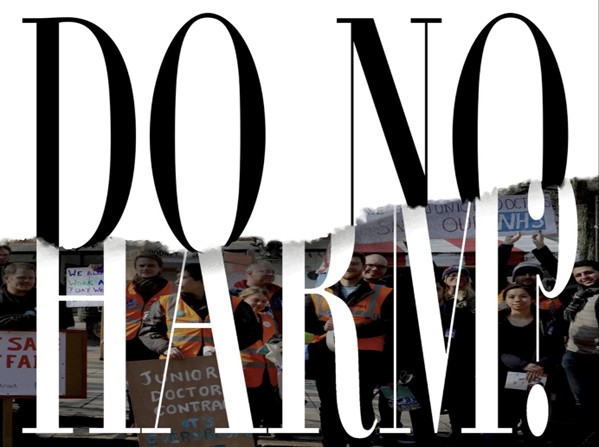
This is Part 1 of the Gazette’s “Do No Harm?” feature, which aims to examine the reasoning and rhetoric on both sides of the resident doctor’s strike debate. Read Part 2, Ffion Wood’s argument against the strikes, here.
Graphic by Suzan Mozak.
“Greedy”, “moaning minnies” and “juvenile delinquents” are just some of the terms being thrown around to describe resident doctors. The very people manning emergency departments at nights, certifying deaths, and supporting families. Now, they face the prospect of unemployment after devoting their late teens and twenties to medicine in the pursuit of public service. Oh, and while being paid barely a meal deal’s worth more than minimum wage.
Even though two thirds of the scathing remarks above came from a cabinet member and not a GB News comments section, it can’t be denied that public support of resident doctor’s strikes is falling, dwindling from a balmy 52% in June last year to just 28% according to a recent Ipsos poll. Undoubtedly, much of this stems from the media framing resident doctors as entitled yuppies, throwing their stethoscopes out the pram since they can’t afford a second ski trip anymore. Everyone’s pockets are hurting, and it doesn’t take much to focus their ire upon the public sector scapegoat of the season (enjoy the break, tube drivers).
But why are they striking if they just had their pay bumped? Despite sorely needed pay rises in the past 3 years, and even after the government’s planned 5.4% uplift over 2025/26, resident doctors will still be earning around 20% less in real terms than they did in 2008 , as calculated using RPI. I’m aware the students already planning their exodus to JP Goldman Stanley would berate me for the economic malpractice of agreeing with the BMA’s use of RPI instead of CPI, arguably inflating the pay erosion figure. However, £100,000+ in loan debt and costs of uprooting your life (multiple times), endless registration and examinations totalling up to £71,000 over the course of training mean that resident doctors are still feeling significantly more financial strain than their older millennial counterparts.
To those unfamiliar with the—conveniently seldom mentioned—training post crisis, competition for jobs post-FY2 has also never been higher. For the budding cardiologists, good luck getting into internal medicine training without a PhD, a first author Nature paper, and a condition named after you. Strikingly (pun intended), this year, there were more than 8,841 applications for just 1,678 IMT spots, almost 3000 more applicants and 20 less posts than in 2024. This is not an isolated case, GP training competition ratios exceed 5:1, and the competition for certain surgical training pathways exceeds an eye-watering 20:1. Other graduates may find these ratios hard to sympathise with, but these are trained doctors with 2+ years of experience now scrambling for work in a system screaming for more staff. With trivial promises of only 1000 new training posts over the next three years when over half of doctors finishing FY2 report a lack of substantive ongoing employment, it’s clear that industrial action is required to force the government this crisis seriously.
No matter whether you think doctor’s strikes are immoral, banning doctors from industrial action will only make things worse. Aside from confiscating their passports, there would be no way to prevent thousand more British-trained doctors (which cost the taxpayer around a quarter of a million, by the way) from upping sticks to Australia, New Zealand, Canada and even (gasp) the US. Even if you did, the aforementioned finance defector pool would skyrocket.
I hate to accuse the tabloids of not using high quality peer reviewed evidence in their unbiased analyses of how resident strikes affect outcomes, but the data has consistently demonstrated that there is no statistically significant increase in hospital and community mortality. One 2022 meta-analysis of seventeen observational studies showed no change in risk ratio of mortality between strike and control periods, irrespective of country, profession striking (nurses or doctors), and duration. Furthermore, over 95% of elective procedures continued as planned in the November strikes, so the “would you go in if someone was dying” ultimatums issued by TV pundits are blatantly sensationalist and fabricated. Granted, any elective procedure being pushed back causes undue suffering. Nevertheless, the alternative to striking and systemic change is much worse: more patients receiving subpar and undignified corridor care, understaffing so high that residents are sleeping in their cars as to not crash on the way home, and a postgraduate landscape so bleak that a third of medical students are already planning their escape abroad or from medicine entirely, kicking the crutches away from our already limping NHS (and who can blame them?).
Of course, nobody wants to strike. But when resident doctors are facing a jobs crisis, paid less than ever before in inarguably worse conditions, and met with a government that resorts to name calling rather than negotiation, there isn’t much of a choice. If you’re asking whether doctors can ethically afford to allow a minority of our patients to wait longer than they otherwise should, the real question is can we afford to kick the can down the road until we lose the brilliant, highly educated doctors that patients deserve.
This is Part 1 of the Gazette’s “Do No Harm?” feature, which aims to examine the reasoning and rhetoric on both sides of the resident doctor’s strike debate. Read Part 2, Ffion Wood’s argument against the strikes, here.
Graphic by Suzan Mozak.